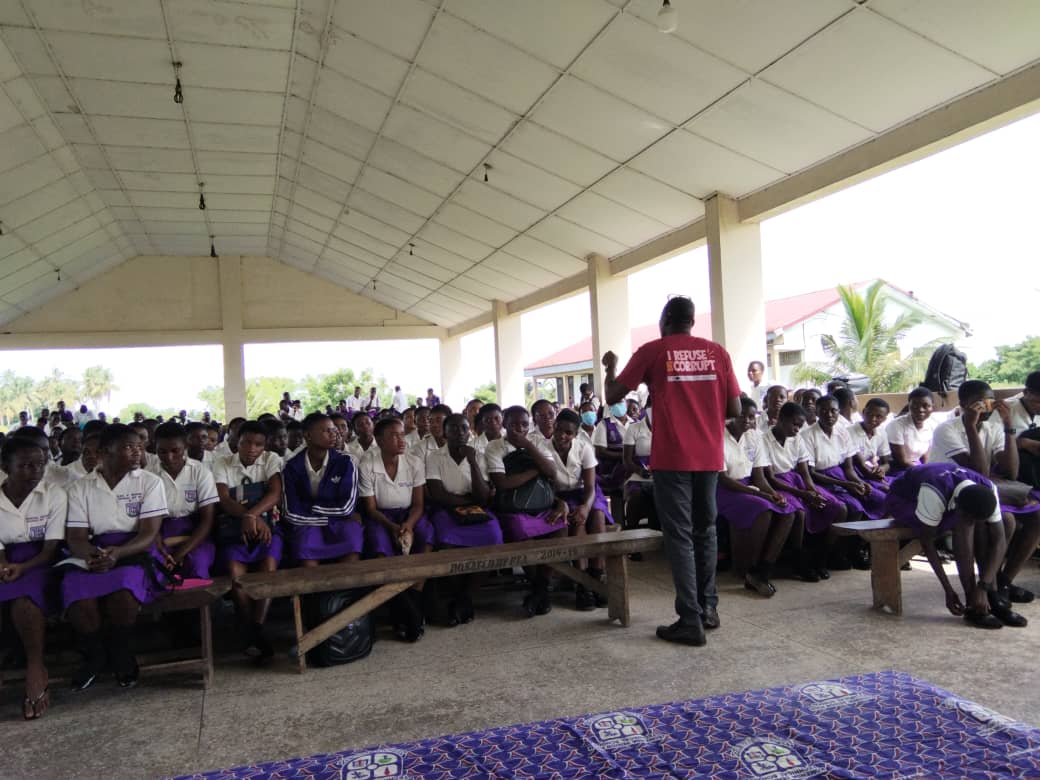
The National Commission for Civic Education (NCCE) in the Komenda-Edina-Eguafo-Abrem (KEEA) Municipality has organized a civic engagement program for students of Komenda Senior High Technical School on the rule of law and the fight against corruption.
The program, held on May 28, 2026, at the school’s Assembly Hall, brought together 431 Form Two students, made up of 141 males and 290 females.
The engagement forms part of a two-year project being implemented by the NCCE in partnership with Deutsche Gesellschaft für Internationale Zusammenarbeit (GIZ) GmbH and co-funded by the European Union (EU) to strengthen civic participation and promote accountability and integrity in society.
The activity focused on issues including corruption, ethical leadership, conflict of interest, abuse of office, influence peddling, and public accountability, with the aim of fostering transparency and respect for the rule of law among students.
Addressing the gathering, the Headmaster of Komenda Senior High Technical School, Mr. Frederick Inkoom, expressed appreciation to the NCCE for selecting the school for the program. He urged the students to pay close attention to the discussions and apply the lessons in their daily lives.
Mr. Inkoom noted that the engagement marked the beginning of the school’s Value Learning Community (VLC), while teachers would also participate in a Professional Learning Community (PLC).
The Municipal Director of the Commission on Human Rights and Administrative Justice (CHRAJ), Mr. Eric Arthur Fynn, educated the students on corruption and its various forms, including bribery, embezzlement, nepotism, and extortion.
He explained that corruption involves the use of power or position for personal gain and stressed the need for accountability and ethical conduct in leadership.
Mr. Fynn also described influence peddling as the use of personal connections to gain unfair advantages and highlighted the importance of the rule of law, where everyone is equal before the law and leaders are equally bound by it.
Speaking on ethical leadership, he encouraged the students to uphold integrity, transparency, fairness, responsibility, and service to others.
Assistant Director of the NCCE, Mr. Daniel Abawana, also took the students through lessons on conflict of interest and abuse of office.
He explained that conflict of interest arises when a person uses an official position for private benefit and identified perceived, potential, and actual conflict of interest as the major forms.
Mr. Abawana further stated that abuse of office occurs when public officials misuse their authority for personal gain, favoritism, revenge, or unlawful purposes, warning that such acts undermine public trust and national development.
The students actively participated in the engagement and were encouraged to become responsible citizens committed to integrity, accountability, and the rule of law.





_
Follow us on our social media pages for more stories and posts from the NCCE.

https://www.instagram.com/nccegh/

https://www.facebook.com/nccegh/
Leave a comment